Early Life and Education
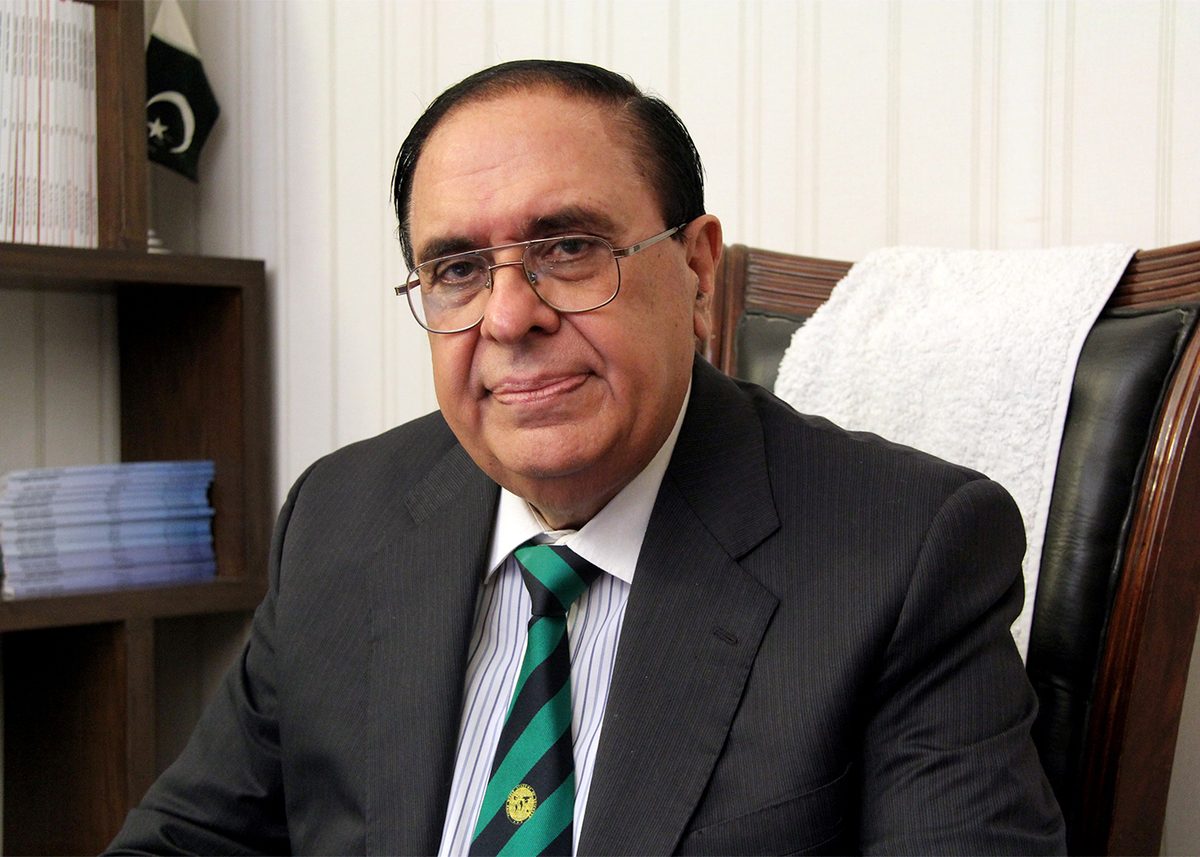
Atta-ur-Rahman was born on 22 September 1942 in Old Delhi during the British Raj. His family relocated to Lahore in 1946 and later settled in Karachi in 1952. He comes from a distinguished academic family — his grandfather, Sir Abdur Rahman, was Vice-Chancellor of the University of Delhi (1934–1938) and later a Senior Justice of Pakistan's Supreme Court.
He completed his O-Levels and A-Levels at Karachi Grammar School, topping his class. He earned his B.Sc. (Honours) and M.Sc. in Organic Chemistry from the University of Karachi with first-class honours, then received his PhD in Organic Chemistry from King's College, University of Cambridge in 1968, under the supervision of J. Harley Mason, working on synthetic studies in the indole alkaloid field. He was later awarded a Doctor of Science (Sc.D.) by Cambridge University in 1987.
Scientific Career and Research
Dr. Atta-ur-Rahman joined the University of Karachi as a lecturer in 1964 and rose through the ranks to become the driving force behind the Hussain Ebrahim Jamal (HEJ) Research Institute of Chemistry — now the International Center for Chemical and Biological Sciences (ICCBS) — which he built into one of the most advanced research institutions in the developing world.
His research specialises in natural products chemistry, NMR spectroscopy, and organic synthesis. He achieved the first synthesis of vinblastine, a powerful anti-cancer alkaloid from the rosy periwinkle plant, patented in the UK, Germany, and Pakistan in 1978. He discovered over 500 novel bioactive chemical compounds from Pakistani flora with antimicrobial, anticancer, and enzyme-inhibitory properties. He also authored the world's first textbook with a detailed treatment of two-dimensional NMR spectroscopy, which was translated into Japanese in 1988, and has edited 82+ volumes of the Elsevier series Studies in Natural Products Chemistry — the world's leading encyclopedic series on the subject.
He has supervised 83 PhD students to completion, published 1,108+ scientific works, and holds 83 international patents. His h-index stands at 65 with over 27,000 citations.
Role as HEC Chairman and Education Reforms
Perhaps his most consequential public role was as the founding Chairman of the Higher Education Commission (HEC) of Pakistan from October 2002 to September 2008. Under his leadership, HEC revolutionised Pakistani higher education: the number of universities expanded dramatically, thousands of scholars were sent abroad for PhDs on government scholarships, digital library access was extended to all Pakistani institutions, and research output increased manifold. This period is widely described as Pakistan's golden era in higher education.
Prior to HEC, he served as Federal Minister for Science and Technology (2000–2002) and Federal Minister of Education (2002) under President Pervez Musharraf. He has also served as Coordinator General of COMSTECH (OIC Standing Committee on Scientific and Technological Cooperation) from 1996 to 2012, and as President of the Pakistan Academy of Sciences (2003–2006 and 2011–2014).
Books and Publications
Dr. Atta-ur-Rahman is one of the most prolific scientific authors in the Muslim world, having authored or edited over 366 books published by Oxford University Press, Springer-Verlag, Elsevier, Academic Press (USA), and Plenum Press (USA). Notable titles include Nuclear Magnetic Resonance Spectroscopy (Springer, 1986) — the first textbook globally with a comprehensive 2D-NMR treatment — and Solving Problems with NMR Spectroscopy (Academic Press, 1996), which carries a foreword by Nobel Laureate R.R. Ernst.
He is editor of the Elsevier series Studies in Natural Products Chemistry, which has grown to 82+ volumes since 1988 and is the world's leading reference work in its field. He is also Editor-in-Chief of eight European chemistry journals, including Current Medicinal Chemistry.
Awards and Honours
Dr. Atta-ur-Rahman is Pakistan's most decorated scientist, having received all four of Pakistan's highest civil awards: Tamgha-e-Imtiaz (1983), Sitara-e-Imtiaz (1991), Hilal-e-Imtiaz (1998), and Nishan-e-Imtiaz (2002). He was the first Muslim scientist to receive the UNESCO Science Prize (1999). Other major international honours include the Government of China's Friendship Award (2014), the International Science & Technology Cooperation Award from the Chinese Academy of Sciences (2014 and 2020), the Einstein Professorship of the Chinese Academy of Sciences (2013), and the Grand Gold Decoration of Honour with Sash from Austria (2007).
He was elected Fellow of the Royal Society (FRS), London in 2006 — one of the highest honours in world science — and is a Foreign Academician of the Chinese Academy of Sciences (2015). He holds honorary doctorates from Cambridge, Coventry University (UK), University of Bradford (UK), Asian Institute of Technology (Thailand), and Universiti Teknologi MARA (Malaysia). Institutions in Pakistan and Malaysia have been named in his honour, including the Atta-ur-Rahman School of Applied Biosciences at NUST, Islamabad, and the Atta-ur-Rahman Institute for Natural Product Discovery in Malaysia.
References
Categories
Photo Gallery